

A low-stress home is one where the everyday systems quietly handle their jobs and leave the household free to enjoy the space. Cool air flows evenly through every room in July, bathrooms stay organized and dry, and the yard needs only light attention because water drains properly, canopies are healthy, and the backyard swim area stays clear. Getting there does not require constant effort. It requires good design, quality installation, and a reasonable schedule of care that keeps small problems from snowballing into major repairs.
The opposite scenario is familiar to many owners. A cooling system struggles through a heat wave, water drips under a vanity until the cabinet base swells, and overflowing channels at the eaves wash mulch into the lawn. Overhanging limbs scrape shingles, insects multiply in damp drawers, and an overdue tank service sends wastewater back toward the house. Each issue adds work, cost, and frustration. Cooler summers, tidier baths, and a yard that takes care of itself come from building the right systems into the property and maintaining them before they demand attention.
Reducing Heavy End Weight and Clearing Overhanging Limbs

Long, horizontal limbs gather foliage at their tips over many years, creating end weight that places tremendous stress on branch attachments. During storms, wind, ice, and wet leaves magnify that load, and limbs can crack or tear away from the trunk. Branches that extend over the house drop leaves and twigs into drainage channels, scrape shingles, shade the shell so moss and algae can grow, and give squirrels and rodents easy access to the eaves and attic.
A trusted local tree service begins with an assessment by an ISA Certified Arborist, who identifies overextended limbs, weak attachments, and clearance issues. Following ANSI A300 standards, crews perform reduction cuts back to lateral branches at least one-third the diameter of the removed portion, shortening limbs and reducing end weight without topping. Branches over the house are pruned back to maintain six to ten feet of clearance from shingles and siding, and limbs over walkways and driveways are raised. Debris is chipped and removed, leaving the canopy healthier and the house better protected.
Vacuuming Infested Drawers and Applying Growth Regulators
Bathroom and kitchen drawers, vanity bases, and storage areas offer cockroaches warmth, darkness, and moisture, especially where plumbing leaks or condensation keep surfaces damp. German cockroaches deposit egg cases in hinges, drawer slides, and corners, and populations grow quickly when left undisturbed. Droppings, shed skins, and odors contaminate stored towels, toiletries, and kitchen items, and the allergens they produce can trigger asthma and allergies in sensitive household members.
Thorough cockroach control begins with an inspection using flashlights and sticky monitors to identify heavily infested areas. Drawers and cabinet interiors are emptied and vacuumed with HEPA-filter vacuums to remove live insects, egg cases, droppings, and debris, immediately reducing the population. Gel baits are applied in hinges, cracks, and voids, and insect growth regulators such as pyriproxyfen or hydroprene are applied to prevent nymphs from developing into reproductive adults, breaking the breeding cycle. Plumbing leaks are repaired, gaps around pipes are sealed, and follow-up visits monitor results.
Calculating Runoff Volumes and Sloping Continuous Troughs
Drainage channels that are undersized or poorly pitched cannot keep up with heavy rain, sending water over the edges and onto siding, walkways, and planting beds. Water that pools in troughs adds weight, pulls hangers loose, and breeds mosquitoes, while overflow saturates the soil along the foundation, leading to wet basements, cracked slabs, and erosion. Over time, constant moisture rots fascia boards and creates conditions that attract insects.
Professional gutter installation begins with calculating runoff volumes based on roof area, pitch, and local rainfall intensity, using these figures to size channels and determine the number and placement of downspouts. Continuous aluminum troughs are formed on site to match each eave, eliminating leaky seams. They are hung with hidden hangers every 24 inches, fastened with structural screws into rafter tails, and sloped a quarter inch per ten feet toward outlets. Oversized downspouts, extensions, or underground drains carry water away, and leaf guards reduce cleaning.
Replacing Weathered Ridge Caps and Sealing Skylight Curbs
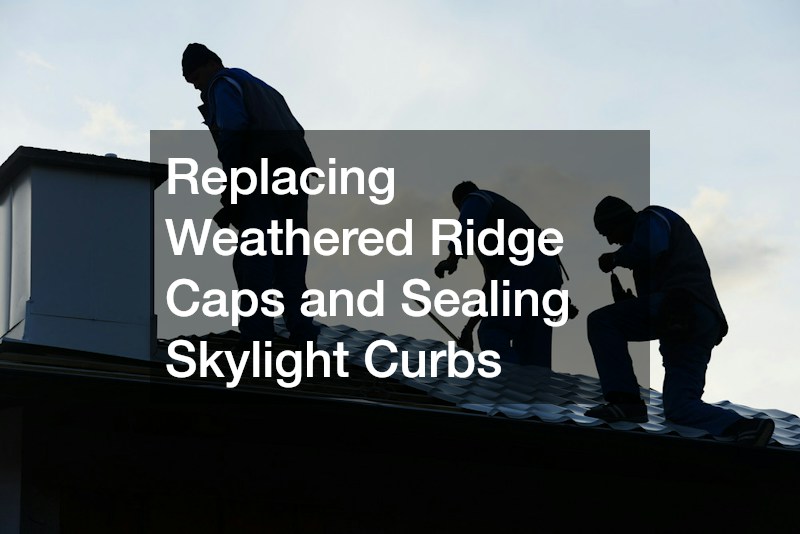
Ridge caps take the full force of wind and sun at the highest point of the shell, and over time they crack, lose granules, and lift, exposing nail heads and allowing water to seep in. Skylights bring natural light into living spaces, but the curbs and flashing around them are common leak points, especially when sealants dry out, step flashing corrodes, or debris collects on the uphill side. Leaks around skylights often stain ceilings and damage drywall and insulation.
Reputable local roofing companies begin with a careful inspection of ridge caps, flashing, skylights, and penetrations, along with an attic check for leaks and damp insulation. Weathered ridge caps are removed and replaced with new hip and ridge shingles fastened with longer nails to penetrate the decking, and exposed fasteners are sealed. Around skylights, old sealant is removed, step flashing and head flashing are inspected and replaced as needed, and manufacturer flashing kits with ice-and-water membrane are installed for watertight protection.
Shocking Cloudy Water and Scrubbing Algae-Prone Corners
Cloudy water in a swim area usually signals low sanitizer, high combined chlorine, poor filtration, or an imbalance in pH or alkalinity. Organic contaminants from swimmers, rain, and debris consume free chlorine and form chloramines, which cause odors and eye irritation. Corners, steps, and areas behind ladders often have weak circulation, allowing algae to establish itself in places that brushes and automatic cleaners miss, eventually spreading across larger surfaces.
Consistent pool maintenance begins with testing free chlorine, combined chlorine, pH, alkalinity, calcium hardness, and cyanuric acid. When the water is cloudy or combined chlorine is elevated, it is shocked to breakpoint chlorination, typically raising free chlorine to ten times the combined chlorine level, ideally in the evening to minimize ultraviolet loss. Corners, steps, and areas behind ladders are scrubbed with stiff brushes, and the filter runs continuously until the water clears. Filters are cleaned or backwashed, and circulation patterns are adjusted with return fittings. Phosphate removers and weekly brushing help prevent algae from returning.
Selecting Moisture-Resistant Vanities and Adding Recessed Medicine Storage
Bathrooms are humid spaces, and standard particleboard vanities swell, delaminate, and sag when exposed to water from splashes, leaks, and steam. Shelves warp, doors misalign, and finishes peel, leaving the room looking worn. Limited storage forces toiletries, towels, and cleaning supplies onto counters and floors, creating clutter that makes the space harder to clean and less pleasant to use, especially in shared and family bathrooms.
Well-built bathroom cabinets start with materials chosen for moisture resistance, such as marine-grade plywood or solid wood boxes with water-resistant finishes, and soft-close hinges and full-extension drawer slides with stainless or coated hardware. Vanities are installed level and secured to studs, with plumbing access cutouts sealed to prevent moisture intrusion. Recessed medicine storage is installed between wall studs, providing storage without protruding into the room, and is often paired with integrated lighting, mirrored doors, and outlets for electric toothbrushes and razors.
Testing Failed Igniters and Recalibrating Faulty Thermostats

Heating equipment that sits idle through summer can develop problems that appear during the first cool nights of fall, when a cracked hot surface igniter fails to light the burners. Thermostats that are miscalibrated, poorly located, or wired incorrectly cause temperature swings, short cycling, and uneven comfort, making some rooms too warm and others too cool. Faulty thermostats also waste energy by running equipment longer than necessary or failing to switch between modes properly.
Prompt HVAC repair begins with reading diagnostic codes on the control board and observing the ignition sequence. Hot surface igniters are tested for resistance with a multimeter and replaced with matched silicon nitride units when cracked or out of range. Flame sensors are cleaned, and safety controls are tested. Thermostats are checked for proper wiring, location, and calibration, comparing their readings to a calibrated reference thermometer, and adjusted or replaced. Smart thermostats are configured with correct equipment settings and schedules. Gas pressure, temperature rise, and carbon monoxide levels are verified before the system returns to service.
Fixing Running Toilets and Replacing Corroded Supply Valves
A running toilet can waste hundreds of gallons of water per day, often due to a worn flapper, a misadjusted float, or a faulty fill valve. Corroded multi-turn supply valves under sinks and toilets seize or leak, making it impossible to shut off water quickly during an emergency. Slow leaks at these valves and connections damage cabinet bases, floors, and subfloors, causing swelling, mold, and costly repairs that often go unnoticed until the damage is extensive.
A dependable local plumber begins by diagnosing running toilets, checking the flapper, flush valve seat, fill valve, and float height, and replacing worn components with matched parts. Dye tests confirm whether the flapper is sealing properly. Corroded supply valves are replaced with quarter-turn ball valves, and old rigid or rubber supply lines are replaced with braided stainless lines. Connections are tightened and checked for leaks, and cabinet bases are inspected for water damage, with moisture readings taken to confirm the area is dry.
Recharging Low Refrigerant and Straightening Bent Condenser Fins
Cooling systems are sealed, so low refrigerant always indicates a leak, often at brazed joints, Schrader valves, or corroded coils. Low charge reduces cooling capacity, causes evaporator coils to freeze, and forces compressors to work harder, risking costly failure. Condenser fins bent by hail, lawn equipment, or debris restrict airflow across the coil, raising head pressure and operating temperatures and reducing efficiency, especially on the hottest summer days.
Reliable air conditioner repair begins with measuring system pressures, superheat, and subcooling to confirm low charge, then locating leaks using electronic detectors, bubble solution, or nitrogen pressure testing. Leaks are repaired by brazing under a nitrogen purge or replacing faulty valve cores and coils, then the system is evacuated to 500 microns and recharged by weight to manufacturer specifications. Bent condenser fins are straightened with a fin comb matched to the fin spacing, and the coil is cleaned with a foaming cleaner and rinsed from the inside out.
Pumping Accumulated Sludge and Monitoring Drain Field Health

Onsite wastewater systems depend on regular care to function properly. Solids settle in the tank as sludge, and if they are not removed, they eventually escape into the drain field, clogging the soil and pipes. Once the drain field fails, wastewater surfaces in the yard or backs up into the house, and repairs can be extensive and expensive. Signs of trouble include slow drains, gurgling pipes, sewage odors, and soggy or unusually green areas over the field.
Routine septic maintenance begins with locating and uncovering the tank lids, measuring sludge and scum layers, and pumping the tank every three to five years or as needed based on household size and usage. Technicians inspect baffles and effluent filters, cleaning or replacing them as needed. The drain field is monitored for signs of saturation, odors, and lush growth, and inspection ports are checked for standing effluent. Water usage is spread out, and grease, wipes, and harsh chemicals are kept out of the system. Risers installed over the lids make each future service visit faster and less disruptive to the lawn.
Cooler summers, tidier baths, and a yard that takes care of itself depend on systems and spaces that are well designed and properly maintained. Reliable heating and cooling keep rooms comfortable, and moisture-resistant storage keeps bathrooms organized and dry. Well-maintained plumbing prevents leaks and wasted water, while targeted pest management keeps insects out of drawers and cabinets.
Outside, healthy canopies, properly sized drainage channels, a sound shell, a clean swim area, and a well-maintained wastewater system keep the yard safe and low maintenance. Regular inspections and seasonal service, such as cooling checkups in spring, heating checks in fall, tank pumping on schedule, and drainage cleaning before storms, catch small issues before they turn into emergencies. Keeping a simple log of service dates and findings helps owners see which systems need attention next.
The reward is a home that delivers comfort and convenience with minimal effort. With skilled workmanship, quality materials, and consistent care, homeowners can spend less time on repairs and more time enjoying cooler summers, organized spaces, and a yard that truly takes care of itself.